For many of the property owners we work with, real estate investing did not begin with a business plan, a five-property portfolio or a carefully mapped-out strategy to build generational wealth.
It started with a house. Or a condo. A place they bought because they needed somewhere to live.
Then, somewhere along the way, that property became a rental. Maybe they moved in with a spouse. Maybe they purchased a larger home. Maybe they relocated for work. Maybe the market wasn't where they wanted it to be when they were ready to move. Or maybe they simply realized they could rent the property, cover the expenses and hold onto an asset that had the potential to continue appreciating.
The first decision was often pretty simple: "Let's rent it and see what happens."
A few years later, however, the conversation can look very different. The property has appreciated. The mortgage has been paid down. The rent has increased. Equity has accumulated. And now, instead of simply owning the home you used to live in, you own an investment property.
That is when I think owners need to begin changing the way they look at real estate.
Not every rental property should automatically be sold. And not every investor needs to pursue a 1031 exchange. Sometimes the best strategy is to keep doing exactly what you are doing. But as an owner builds equity and gains experience, it is worth periodically asking a bigger question:
"Is this property still the best place for my investment?"
That question—not simply the desire to avoid taxes—is where a 1031 exchange conversation should begin.
A 1031 Exchange Starts With an Investment Mindset
I think one of the biggest misconceptions about a 1031 exchange is that it is simply a tax strategy you consider when you decide to sell. In reality, the most successful conversations around a potential exchange often begin much earlier. They begin when an owner starts looking at their property as an investment rather than simply as a home they happen to be renting out.
There is a difference.
The emotional attachment to a former home can be strong. You remember buying it. You remember the renovations. Maybe you raised a family there. Maybe you spent years fixing it up. Even after becoming a rental, it can still feel like your home.
But an investment property has to be evaluated differently.
- How is it performing?
- What is the return on the equity tied up in the property?
- What are the maintenance costs?
- Is the rental income keeping pace with the market?
- What does the building or neighborhood look like five or ten years from now?
- Are there upcoming capital expenses?
- Could the equity in this property be working harder somewhere else?
Those are investment questions. And sometimes the answer will reinforce your decision to hold onto the property. Other times, it may lead you to consider whether selling and reinvesting makes more sense.
A properly structured Section 1031 exchange can allow an owner to exchange qualifying real property held for business or investment purposes for other qualifying real property and defer recognition of gain under the applicable rules. Importantly, Section 1031 treatment is now limited to qualifying real property—personal and intangible property generally no longer qualifies.
That creates an opportunity for investors to think about repositioning their real estate rather than simply selling and walking away.
What Does "Like-Kind" Actually Mean?
This is probably one of the most misunderstood parts of the 1031 exchange. When people hear the phrase like-kind exchange, they often assume the replacement property has to look similar to the property they are selling: a condo for a condo, a townhouse for a townhouse, a duplex for another duplex.
Fortunately, real estate investing gives you much more flexibility than that.
For Section 1031 purposes, qualifying real properties generally are considered like-kind based on their nature or character as real property—not because they are identical in appearance, quality or use. The IRS specifically notes that improved and unimproved real property can generally be like-kind. For example, city property can generally be exchanged for farm property, and an apartment building can generally be exchanged for another type of qualifying real estate investment.
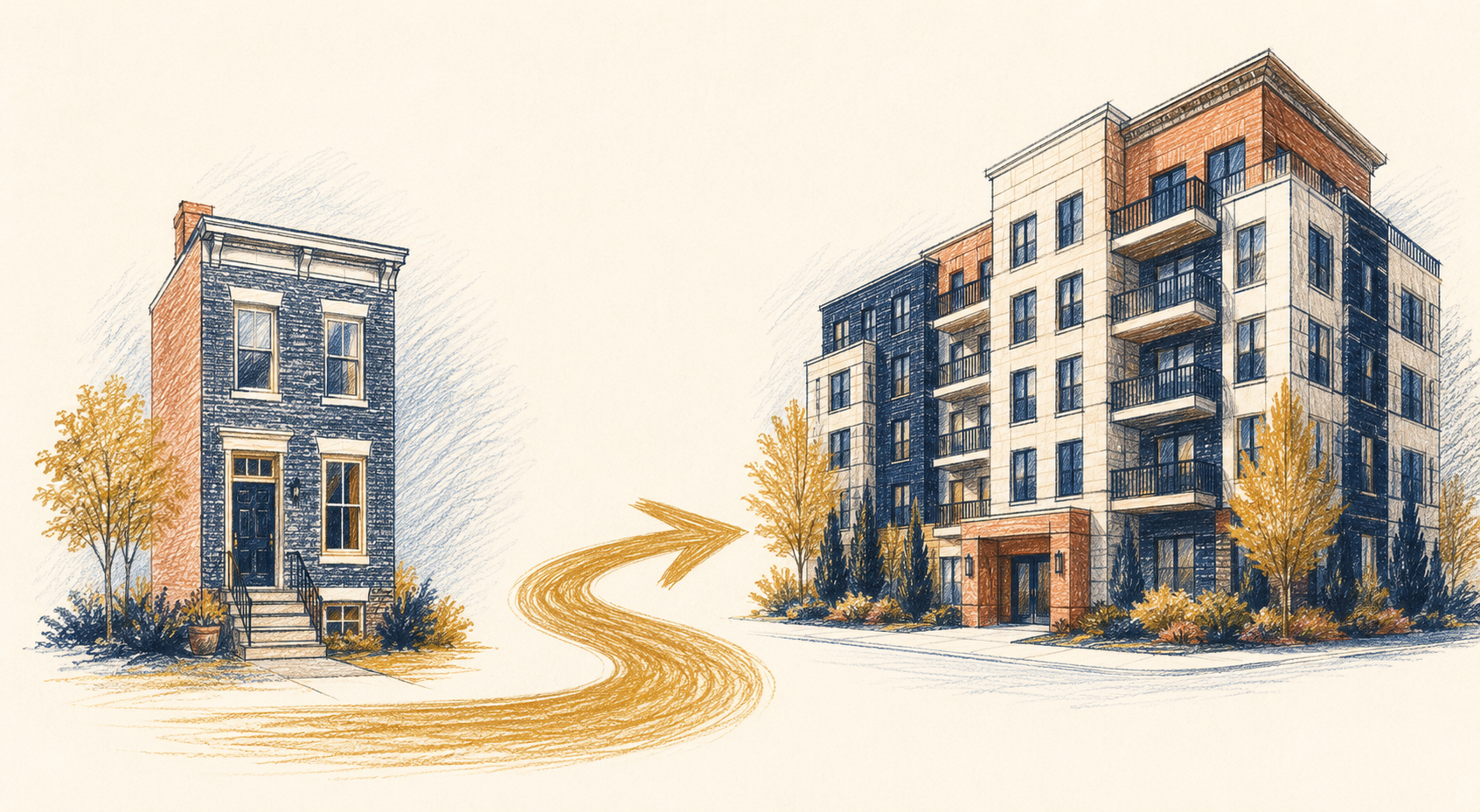
That means an owner could potentially move from one type of investment into another. For example:
REPOSITIONING IN PRACTICE
|
The important point is that the property being relinquished and the replacement property generally must be held for investment or productive use in a trade or business. Personal-use property and property held primarily for sale generally do not qualify for Section 1031 treatment. There is also an important geographic distinction: real property located in the United States is not considered like-kind to real property located outside the United States.
This flexibility is what makes the 1031 exchange worth understanding from an investment perspective. You are not necessarily stuck replacing one rental with another property that looks exactly the same. You may have the opportunity to change your strategy. And sometimes that is the real value of the exchange.
Your Investment Strategy Can Change as Your Life Changes
Let's go back to the accidental landlord. You bought a two-bedroom condo ten years ago. You lived there for several years, eventually moved out and turned it into a rental. At first, it worked perfectly. The rent covered the mortgage and expenses. The property appreciated. You built equity.
But ten years later, you may find yourself in a very different position. Perhaps the condo fees have increased significantly. Maybe the building is facing major capital projects. Maybe the rental income has flattened. Or maybe the property is still performing reasonably well, but you now have enough equity to consider a different type of investment altogether.
That doesn't mean the condo was a bad investment. Actually, it may mean the opposite. The property may have done exactly what you needed it to do. It helped you build equity. It generated rental income. It gave you experience as a landlord. And now, you may have an opportunity to use that accumulated equity to take the next step.
This is where owners need to begin thinking about the life cycle of an investment. Buying a property is one decision. Holding it is another. Selling it is another. And deciding what to do with the proceeds can be just as important as deciding to sell in the first place.
Preparing for an Exchange Before You Need One
You don't need to decide today that you are going to complete a 1031 exchange. But if you own an investment property, I do think there are things you can do now that will put you in a better position to evaluate your options later.
1. Know What You Actually Own
This sounds obvious, but many accidental landlords don't regularly evaluate their equity position. They know what they paid for the property. They know approximately what the mortgage balance is. And they may have a general idea of what the property is worth. But those numbers can change significantly over time.
A property that was purchased for $350,000 and now has a market value approaching $650,000 is a very different investment than the one you originally purchased.
The first step is understanding the asset you have today—not the one you bought years ago. What is its approximate market value? What is the outstanding debt? What has the property historically produced? What are the projected expenses? And what is the opportunity cost of continuing to hold that equity in its current location?
Again, these are not questions with automatic answers. But they are questions an investor should periodically ask.
2. Keep Good Records
Tax planning is difficult when the records are incomplete. Owners should maintain records related to their purchase, capital improvements, depreciation and other items that may be relevant to their tax position. The basis of property received in a like-kind exchange is generally connected to the basis of the property given up, which is one reason accurate records matter throughout the life of an investment.
This is where your accountant or tax advisor becomes particularly important. As a property manager and real estate broker, we can help owners understand the real estate side of the equation—market value, rental performance, potential acquisition opportunities and the operational realities of different types of properties. But we are not accountants or attorneys. Your CPA and legal advisors should help you understand the tax and legal consequences of the decisions you are considering.
Ideally, those conversations happen before there is a signed sales contract sitting in front of you.
3. Start Watching Opportunities Before You Sell
This is where I think property owners can gain a significant advantage. If you believe that you may eventually want to sell or reposition an investment, start paying attention to potential replacement opportunities now.
What markets interest you? Are you interested in staying local? Would you rather own multiple smaller properties or one larger asset? Do you want more cash flow? Less management? A different tenant profile? A property with redevelopment potential? A building where improvements could increase future income?
The more you understand what you want to accomplish, the easier it becomes to evaluate whether your current property is helping you get there.
"If I decide to sell, what would I want to own next—and why?"
That is a very different approach than treating a sale as something to figure out after the fact.
The Opportunity Is in Repositioning the Investment
The real opportunity created by a potential exchange is not simply that taxes may be deferred. The opportunity is that an owner may be able to reposition capital.
Maybe you have a property with significant appreciation but relatively modest cash flow. You may be able to exchange into a property that produces more income. Or perhaps you own several properties scattered throughout the region and would prefer to consolidate into one larger asset. Maybe you want to move away from an aging property that requires increasing capital investment. Maybe your local market has performed well, and you are interested in diversifying geographically. Or maybe the property you own is perfectly fine—but it no longer aligns with your goals.
A 1031 exchange can potentially give an investor the ability to change the composition of their real estate holdings without necessarily treating every sale as the end of the investment story. Instead, the sale can become a transition.
That is why I encourage owners to think beyond the immediate transaction. The question isn’t simply "Should I sell?" It may also be: "If I sold, what opportunity would that create?"
A Few Important Things That Don't Qualify
While the definition of like-kind real property is broader than many people realize, there are still important limitations.
DOES NOT GENERALLY QUALIFY Your personal residence, when held solely for personal use. Real property held primarily for sale. And, since changes made under the Tax Cuts and Jobs Act, anything that isn't qualifying real property—vehicles, equipment, artwork, patents and other personal or intangible property. |
This is particularly important for the accidental landlord because the history of the property matters. A home that was once your primary residence but has since become a rental may create a more complicated planning conversation than a property that was purchased and held exclusively as an investment.
There can also be circumstances where rules relating to the sale of a primary residence and Section 1031 intersect. The IRS provides specific guidance regarding properties that have been used as both a home and rental property, including rules surrounding depreciation and potential gain exclusions.
This is exactly why owners should not make assumptions based on something they heard from another investor—or, frankly, from a real estate agent who isn't qualified to give tax advice. Your circumstances matter. How long you lived in the property matters. How long it has been rented may matter. How depreciation has been handled matters. Your ownership structure may matter. And your future plans for the replacement property matter. That is a conversation for the appropriate tax and legal professionals.
Building a Team Before the Opportunity Arrives
Real estate investors often wait until they have a deal before they start building the team necessary to evaluate it. I think the better approach is to know who is going to be involved before the clock starts. Depending on the transaction, that may include:
- Your CPA or tax advisor
- An attorney
- A real estate broker
- A property manager
- A lender
- A qualified intermediary, when appropriate
A properly structured exchange requires attention to specific rules, and an investor generally cannot simply sell the property, take possession of the proceeds and later decide to use that money for a 1031 exchange. The IRS recognizes the use of a qualified intermediary or other permitted arrangements to help avoid actual or constructive receipt of the exchange proceeds.
And this is where I am intentionally going to stop short of getting into the detailed mechanics—because there is another conversation we need to have about timing. The deadlines associated with identifying replacement properties, completing an exchange and properly structuring the transaction are among the most important aspects of the entire process, and probably where some of the biggest mistakes can occur. That deserves its own discussion.
The Bottom Line: Start Thinking Like an Investor Before You Need to Act Like One
A 1031 exchange isn't something every rental property owner needs to pursue. And it certainly isn't something to do simply because someone tells you that you can defer taxes.
The real question is whether selling your current property and acquiring another investment would help move you closer to your long-term goals. For some owners, the answer will be no. For others, the answer may be the beginning of the next phase of their real estate journey.
And that is really the point.
If you started as a first-time homebuyer and eventually became an accidental landlord, you may already be further along in your investment journey than you realize. You own an income-producing asset. You have likely built equity. You have learned how a rental property performs in the real world.
Now the next step is periodically asking whether you are intentionally managing that investment—or simply continuing to own it because you haven't stopped to consider the alternatives.
As a property management company and real estate brokerage, we help owners look at those alternatives. We can help evaluate the current property, discuss market conditions, identify potential opportunities and help owners think through what their next real estate move might look like. But when it comes to whether a 1031 exchange is appropriate, how it should be structured and what the tax consequences may be, that is where your accountant, attorney and other qualified advisors need to be part of the conversation.
The goal is not simply to own more real estate. It is to make sure the real estate you own is helping you accomplish what you want it to accomplish.
And sometimes, the next opportunity begins with recognizing that the property you have today may have already done its job.
NEXT IN THIS SERIES
Next week, we'll get into the part of the 1031 exchange that requires a lot more preparation and precision: the actual exchange process, the critical timelines, and why waiting until your property is under contract may be one of the biggest mistakes an investor can make.
This article is intended for general educational purposes only and should not be considered tax, legal or financial advice. Section 1031 exchanges involve specific requirements and can have significant tax and legal consequences. Property owners should consult with a qualified CPA, tax advisor, attorney and other appropriate professionals regarding their individual circumstances before making decisions involving the sale or exchange of real estate.
EJF Rentals • Washington DC • Maryland • Northern Virginia • ejfrentals.com • 202.803.7200