"Alexandria, Virginia is one of those rare places where you can trip over a cobblestone, land face-first in front of a building where George Washington drank ale, and accidentally walk into what was once an active torpedo factory — all before lunch."
Sitting just across the Potomac from Washington, D.C., Old Town Alexandria is a city that wears its eccentricities proudly. It predates the United States itself. It was briefly part of D.C. (we'll get to that). It calls itself the Ice Cream Cone Capital of America. And it once housed enough spite that a man literally built a house out of revenge.
Whether you're a history nerd, a foodie, an art lover, or just someone who wandered off the Metro looking for something interesting — Alexandria will absolutely deliver. Here's your essential, deeply nerdy, thoroughly fun guide to one of Virginia's most quietly wild cities.
✦
Part One
A City With Extremely Strange Origins
Let's start at the beginning, because the beginning is genuinely absurd. In 1669, a man named Robert Howson was gifted the land where Alexandria now sits. Did he build something? Start a town? Plant a flag? No. He traded the whole thing to a Scottish merchant named John Alexander — and the price was three tons of tobacco.
That's it. That's the origin story. Three tons of tobacco, one land deal, and now it's one of the most valuable real estate markets on the East Coast. The city was officially incorporated in 1749 and named — yes — after the Alexander family. So every time someone says "I live in Alexandria," they're quietly honoring a Scotsman who really liked tobacco.
⚑ Founding Fact
Alexandria was officially incorporated as a town in 1749, making it one of the oldest chartered towns in Virginia — predating the United States by nearly 30 years. For a brief but confusing period in the late 1700s, it was actually part of the District of Columbia, before being retroceded back to Virginia in 1847.
Yes, you read that correctly. Alexandria was inside Washington, D.C. — part of the original diamond-shaped federal district — until Virginia took it back. The reasons were complex, involving slavery politics and congressional representation, but the upshot is that Alexandria technically has an identity crisis baked into its founding documents. It's Virginia. No wait, it's D.C. Actually, it's Virginia again. This tracks.
The City That Was Its Own Historic District Before Historic Districts Were Cool
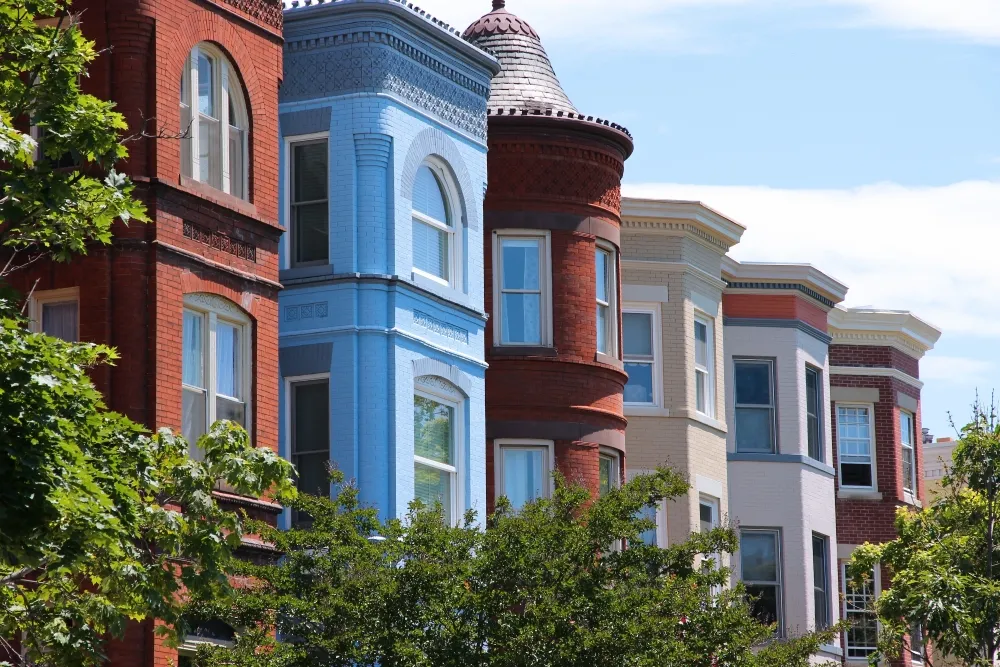
Old Town Alexandria was designated a national historic district in 1949 — only the third city in the entire United States to receive that designation. This was not an accident. With over 3,500 structures listed on the National Register of Historic Places, walking through Old Town is less like strolling through a neighborhood and more like accidentally wandering onto a very tasteful movie set.
The cobblestone streets aren't decorative. Those actual cobblestones were used as ship ballast in the 1700s, brought over from Europe and dumped here when ships needed to unload. The city just… kept them. Because of course it did.
✦
Part Two
Quirky Facts That Will Make You Insufferable at Dinner Parties
Alexandria doesn't just have history — it has specific, deeply weird history. The kind that makes historians laugh and everyone else say "wait, really?" Here are the highlights:
- The Spite Houses. Old Town is home to four narrow buildings known as "spite houses" — structures believed to have been built purely out of personal vendettas. The most famous was built in 1830 by John Hollensbury, a brick master who got tired of horse-drawn carriages cutting through the alley beside his home. His solution? Build a house in the alleyway. The result is a roughly 350-square-foot home, just 7 feet wide and 36 feet deep, still standing on Prince Street today. It is perhaps the pettiest piece of real estate in American history.
- The Hamilton-Burr Duel Connection. Gadsby's Tavern — one of the most famous colonial watering holes in America — was where Thomas Jefferson stayed during the contentious election of 1800. According to local historians, it was this very visit, and the heated conversations within its walls, that set in motion the chain of events leading to the infamous duel between Alexander Hamilton and Aaron Burr. So yes, a tavern in Alexandria is partly responsible for one of history's most dramatic pistol confrontations.
- George Washington Was Basically a Regular. Before he was the Father of the Nation, Washington was just a guy from Virginia who shopped on King Street and worshipped at Christ Church. He attended Christ Church regularly, and it remains an active congregation today — meaning you can sit in a pew where George Washington sat. (Tours are available when services aren't happening, and the building is genuinely beautiful.)
- The Ice Cream Capital Situation. Forbes once declared Alexandria the "Ice Cream Cone Capital of the United States." This is not an unofficial claim — it is a badge the city wears with enormous pride. On King Street alone, you'll find multiple artisanal ice cream shops within walking distance of each other. This is either because Alexandria has exceptional taste or because something in the Potomac water creates ice cream cravings. Possibly both.
- The First Civil War Deaths Hotel. What is now a hotel in Old Town was, in the 1860s, called Marshall House. On May 24, 1861, the day after Virginia's secession was ratified, Union Colonel Elmer Ellsworth climbed to the roof and personally tore down a Confederate flag flying from the inn. The innkeeper shot him. The Colonel's troops then shot the innkeeper. Two deaths, one building, one flag — making it one of the very first civilian sites of Civil War casualties. The hotel still operates today, with its history quietly embedded in the walls.
- The Farmers Market That's Been Running Since George Washington Used It. The Old Town Farmers Market at Market Square has been operating since 1749 — making it one of the oldest continuously running farmers markets in America. Washington himself used to send fresh produce from his Mount Vernon estate to sell here. You can still shop there every Saturday morning, buying vegetables from a market where the Founding Fathers also bought vegetables. This is time travel at its most delicious.
A 7-foot-wide house built out of pure spite. A tavern that helped start a duel. The Ice Cream Capital of America. Alexandria doesn't do anything halfway.
And then there's the Stabler-Leadbeater Apothecary — established in 1792, run by the same family for 141 consecutive years until the Great Depression finally shut it down. Today it's a meticulously preserved museum, complete with original hand-blown glass bottles, handwritten prescription ledgers, and the distinct sensation that you've accidentally walked into the 18th century. It's one of the best small museums in the Washington metro area, and most people walk right past it.
✦
Part Three
Art, Culture, and a Factory That Made Torpedoes
Before we talk about galleries and murals and refined cultural experiences, we need to talk about the torpedo factory. Because there is a torpedo factory. And it is wonderful.
The Torpedo Factory Art Center
Built in 1918 and expanded during World War II, the Torpedo Factory in Alexandria was a fully operational munitions facility — it made actual torpedoes used in actual combat. After the war, it sat largely unused until 1974, when the City of Alexandria decided the most reasonable use for a decommissioned weapons factory on the waterfront was to turn it into an art center.
Today the Torpedo Factory Art Center is one of the largest visual arts centers in the entire United States, housing over 160 professional artists who work, exhibit, and sell their art in open studios. Visitors can watch painters, sculptors, printmakers, jewelers, and photographers at work in real time — not in a recreated artisan village, but in actual working studios where actual art is being made right in front of you.
It's located at 105 N. Union Street, right on the Potomac waterfront, and admission is free. The juxtaposition of "torpedo manufacturing facility" and "thriving arts community" is quintessentially Alexandria — historically serious, creatively irreverent.
The Athenaeum
For a more intimate art experience, the Athenaeum on Prince Street is a spectacular neoclassical building from 1851 that now serves as a gallery for the Northern Virginia Fine Arts Association. The architecture alone is worth the detour — Greek Revival columns, dramatic interior proportions, and rotating exhibitions of contemporary and regional art. Entry is free or by donation. It's the kind of place that makes you feel very cultured while spending approximately nothing.
The Art on the Streets
Old Town's art isn't just indoors. The Alexandria public art collection includes sculptures, installations, and murals scattered throughout the city, with a particularly strong concentration along the waterfront and in the Del Ray neighborhood — a quirky, artsy enclave just north of Old Town proper. Del Ray's main drag, Mount Vernon Avenue, has a neighborhood energy that's part small-town main street, part art school dropout, and entirely lovable.
Gadsby's Tavern Museum
Not strictly an art museum, but a marvel of historic preservation. The museum occupies two buildings — a 1770 tavern and a 1792 hotel — and features period rooms that have been restored with such meticulous care you can practically smell the 18th century. Furnished guest rooms show the personal effects of travelers: their packed luggage, their breakfast setups, the mundane details of lives lived 250 years ago. It's unexpectedly moving. Also: the ghost of a mysterious woman known only as the "Female Stranger" allegedly haunts the place. Make of that what you will.
✦
Part Four
Where to Eat: King Street, Cobblestones, and Cult-Favorite Oysters
Old Town Alexandria has quietly become one of the best dining neighborhoods in the entire Washington, D.C. metro area. The combination of historic atmosphere, waterfront location, and a genuinely diverse culinary scene means you can eat extremely well here — whether your budget is "casual lunch" or "special occasion white tablecloth."
The King Street Rule: King Street is the main artery of Old Town, running from the Metro station straight down to the Potomac waterfront. Most of the restaurants below are within easy walking distance. The street is extremely walkable, extremely charming, and almost always more pleasant than it has any business being.
Historic & Iconic
Gadsby's Tavern Restaurant
Dining in an actual 18th-century tavern where Washington and Jefferson ate. The menu skews colonial-influenced American fare. The experience is unmatched — you're eating history, literally.
138 N. Royal St
Seafood
Hank's Oyster Bar
The gold standard for fresh oysters in Old Town. The happy hour $2.50 oysters and local beer selection draw a devoted crowd. Shrimp po'boys with cayenne remoulade seal the deal. Unpretentious and excellent.
Multiple locations; Old Town on King St
Modern American
Ada's on the River
Named after Ada Lovelace — yes, the 19th-century mathematician widely credited as the first computer programmer — this sleek waterfront spot serves seasonally inspired seafood with stunning Potomac River views. The branding is as smart as the menu.
The Wharf area, waterfront
Indian
Diya Indian Cuisine
The Infatuation's pick for date night in Old Town. Refined Indian cooking in a white-tablecloth setting. The okra masala is a house specialty, the lamb korma is exceptional, and the salmon curry might be the most unexpectedly good thing on any menu in Northern Virginia.
King Street area
Rooftop Bar
Good Fortune Rooftop Bar
The highest rooftop bar in all of Old Town, perched atop Hotel Heron. Panoramic views of the Potomac, the Woodrow Wilson Bridge, and Old Town's roofscape. Craft cocktails, golden hour light, and the gentle realization that you live in a very beautiful part of the country.
699 Prince Street, Hotel Heron
Dessert
Pop's Old Fashioned Ice Cream Co.
The flagship of Alexandria's inexplicable ice cream empire. Pop's is a King Street institution with a vintage atmosphere and scoops that justify the city's Forbes-certified "Ice Cream Capital" status. The line moves, the ice cream is worth it, and the vibe is pure joy.
109 King Street
For the Morning People: Maman
The beloved New York City café recently expanded to Old Town Alexandria, bringing its signature nutty chocolate chip cookies, excellent coffee, and charming French-country atmosphere to the neighborhood. It's the kind of place you sit down for a quick espresso and emerge ninety minutes later, inexplicably calmer.
For the History-and-Beer Crowd
Alexandria has a proud brewing heritage that predates the country, and the city has leaned into it with gusto. A self-guided "Historic Breweries Walking Tour & Pub Guide" takes visitors past 15 pubs and restaurants where beer sampling is highly encouraged. Maps are available at the Alexandria Visitor Center. This is arguably the most educational pub crawl in American history.
✦
Part Five
Practical Tips Before You Go
- Get here by Metro. The King Street-Old Town station puts you right at the top of King Street. From there, the free King Street Trolley runs down to the waterfront and back all day. You genuinely do not need a car.
- Do the Saturday Farmers Market. The Old Town Farmers Market runs every Saturday morning at Market Square — same spot since 1749. Come early, bring cash, buy something George Washington would recognize.
- Walk the waterfront. The Mount Vernon Trail runs along the Potomac and sees over a million pedestrians and cyclists a year. Even a short stretch of it — particularly around the Old Town waterfront — is gorgeous.
- Visit during the holidays. Old Town at Christmas is legitimately magical. The Scottish Christmas Walk Parade and the Holiday Boat Parade of Lights both happen in December and are worth planning a trip around.
- Find the Hollensbury Spite House. It's at 523 Queen Street. It's seven feet wide. It is the most satisfying real estate joke you've ever seen. You'll want a photo.
- Don't skip the Apothecary Museum. The Stabler-Leadbeater Apothecary Museum at 105–107 S. Fairfax Street is one of the most underrated stops in the entire city. The original glass bottles and hand-drawn labels alone are worth the modest admission price.
✦ Final Thought
Alexandria is one of those rare places where the history isn't just preserved — it's alive. The cobblestones are real ship ballast. The taverns served actual Founders. The torpedo factory makes actual art. Come for the ice cream, stay for the layers. You'll leave knowing something you didn't know before, with a scoop in hand and a story to tell.