.jpg)
From a Biblical healing pool to Nobel Prize–winning neighbors, here's everything you never knew you needed to know about one of America's most interesting suburbs.
Somewhere between Washington, D.C.'s monumental grandeur and the quiet sprawl of suburbia sits Bethesda, Maryland — a place that started as literally “a wide spot on the road,” got named after a biblical pool of miraculous healing, and somehow grew into one of the most walkable, art-filled, food-obsessed communities on the East Coast. If you've been sleeping on Bethesda, it's time to wake up.
HISTORY
That Name, Though: The Strange Story of Bethesda
Before the gleaming restaurants and street murals, Bethesda was, in the words of an early resident, “a wide spot on the road.” Specifically, it was a well-traveled trade route running between northern Maryland towns and Potomac River ports, where farmers hauled tobacco, cattle, and food crops toward the growing capital city of Washington, D.C.
The area's first commercial establishment was an old stone tavern that fed and sheltered turnpike travelers in the early 1800s. Glamorous? Not exactly. But necessary? Absolutely. In the 1820s, a local Presbyterian congregation built a small meeting house overlooking the pike — and that modest act of community would eventually give the town its distinctive name.
A Biblical Pool, an Accidental Prophecy
THE NAME ORIGIN In 1871, the community was officially renamed “Bethesda,” drawn from the Biblical Pool of Bethesda in Jerusalem — waters believed to have miraculous healing properties. Given that the National Institutes of Health (NIH) now occupies a massive campus here and employs thousands of scientists working on exactly that kind of healing, the name turned out to be accidentally prophetic. |
By the early 20th century, Bethesda had become a destination. Wealthy Washingtonians built large estates along its shaded roads. The Georgetown Branch railroad connected it to the broader region, and by the mid-1900s, the suburb had fully come into its own. That old railroad line? It's now the Capital Crescent Trail — a beloved walking and biking path that attracts over a million users each year. From freight trains to fitness enthusiasts: that's a glow-up.
|
FACTS
10 Things That Make Bethesda Genuinely Weird (In the Best Way)
Every great place has its quirks. Here are Bethesda's — guaranteed to impress at dinner parties or, at minimum, win a trivia night.
1 Named after healing waters.
The NIH campus here employs over 20,000 people researching exactly that. Biblical foreshadowing: confirmed.
2 Nobel laureates are basically your neighbors.
The NIH campus in Bethesda has been the workplace of multiple Nobel Prize winners. Most suburbs do not have a Nobel laureate count.
3 FDR's Art Deco hospital tower
on the old Walter Reed campus was considered so architecturally magnificent — and so hopelessly inefficient — that it became a local landmark and an Atlas Obscura entry simultaneously.
4 Glen Echo Park was once a full amusement park.
It closed in 1968 and is now a beloved arts and cultural center. From roller coasters to watercolor classes: the second act is better.
5 The Capital Crescent Trail
follows the exact path of the old Georgetown Branch railroad line. Over a million people walk or bike it every year, retracing the footsteps of 19th-century cattle herders.
6 Bethesda consistently ranks among the most walkable suburbs
near Washington, D.C. Its Walk Score is among the highest in all of Maryland.
7 There's a Madonna of the Trail monument
right in downtown Bethesda — one of only 12 identical statues installed across the U.S. to honor pioneer women. Most people walk past it daily. Don't be most people.
8 Downtown's Arts & Entertainment District
is an officially designated State of Maryland arts zone — 300+ acres managed to support galleries, murals, and live performance.
9 Bethesda's restaurant scene rivals D.C.
— with Michelin-recommended chefs and authentic global cuisine sitting right in a Maryland suburb.
10 Taste of Bethesda
brings 60 restaurants and five stages of live entertainment to Woodmont Triangle each October. The culinary equivalent of a greatest-hits album.
WHERE TO EAT
Old Town Bethesda: A Dining Guide for the Hungry and the Curious
Let's be honest: a lot of the reason people come to Bethesda is the food. The restaurant density in its downtown core is startling for a suburb — you'll find everything from Michelin-recognized tasting menus to a Tiki bar that shows up only on Thursdays. Here are the spots worth knowing.
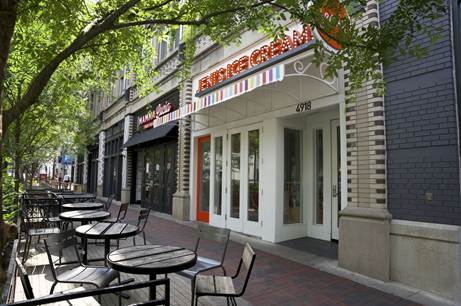
Jeni's and Mamma Lucia sit shoulder to shoulder along Bethesda's shaded downtown sidewalks.
SOUP DUMPLINGS Nan Xiang Soup Dumplings Michelin-recommended and named after the canal town that literally invented soup dumplings, this location serves Lucky Six Soup Dumplings in six colors — gourd, chicken, truffle, pork, scallop, and crab-pork — each hue from natural ingredients. Watch them being filled and folded in the open kitchen. Come hungry. Bring friends who can be trusted not to squeeze the dumpling too fast. |
TIKI BAR (THURSDAYS ONLY) House of Foong Lin — Tiki Pop-Up Every Thursday, this restaurant transforms its bar into something from a Survivor fever dream: puffer fish lanterns, Tiki masks, and tropical imagery everywhere. It's quirky, festive, and appears only once a week. Fans of themed escapism and strong rum drinks, take note. |
JAZZ & BITES The Bethesda Blues & Jazz Supper Club Housed inside a stunning Art Deco theater lovingly restored into a concert venue, this supper club offers excellent food alongside live jazz and blues in an acoustically outstanding, intimate setting. It's the kind of place that makes you feel like you're living inside a 1940s film noir — but with better food and no cigarette smoke. |
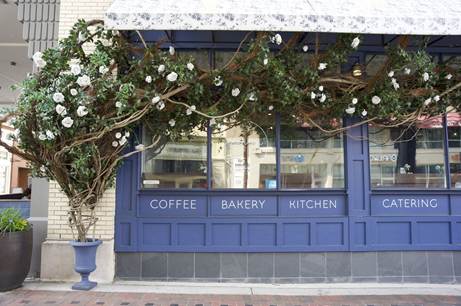
A rose-covered storefront in downtown Bethesda — the kind of detail that turns a quick coffee run into a moment.
FOOD + ARTISANS The Downtown Bethesda Market A unique, intimate, and festive open-air market that brings together great food, local vineyards, breweries, food trucks, artisan crafts, and live music in one gloriously unstructured afternoon. This is not your standard farmer's market — it's more like a boutique festival that shows up reliably. |
CULINARY ROW Bethesda Row The cobblestoned pedestrian stretch that anchors downtown dining and retail. Think high-end boutiques, excellent cafes, and a concentration of restaurants spanning global cuisines — all within a walkable few blocks. If you can't find something to eat here, you're simply not trying. |
WORLD ON A BLOCK Woodmont Triangle The neighborhood that hosts Taste of Bethesda each October also serves as a year-round destination for global dining — from Ethiopian to Korean to Peruvian. Wander in any direction and you'll almost certainly find something extraordinary. |
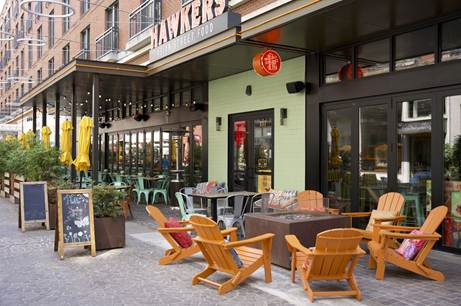
Hawkers Asian Street Food anchors the patio-and-firepit dining scene in Woodmont Triangle.
ART & CULTURE
Murals, Monuments & Museums: The Art Scene You Didn't Expect
Bethesda takes its art seriously. The city's officially designated Arts & Entertainment District covers more than 300 acres of downtown and is actively managed to support public art, galleries, and live performance venues. Since 1974, Montgomery County has required developers seeking higher densities to provide meaningful public amenities — and art became a cornerstone of that exchange.
The result is a downtown dotted with sculptures, murals, and unexpected installations. The Bethesda Urban Partnership maintains a collection of public artworks throughout the district, and the county's online public art map lets you self-guide a walking tour between pins around Bethesda Row and Woodmont Triangle. Grab a coffee and make an afternoon of it.
PUBLIC MONUMENT: Madonna of the Trail One of only 12 identical monuments placed across the United States, this statue in downtown Bethesda honors the courage of pioneer women who helped settle the American frontier. It's historically significant, beautifully rendered, and routinely ignored by people who walk past it every day. Be the person who stops. |
GALLERY DISTRICT: Gallery B & the A&E District The district's anchor gallery hosts rotating juried exhibitions, local artist showcases, and community arts events throughout the year. From award-winning theater to independent film screenings, the district proves that “suburb” and “cultural desert” are not synonymous. |
STREET ART: Downtown Murals & Sculptures New large-scale murals are regularly commissioned throughout Bethesda — including street-level painted murals on roadways. The entire downtown doubles as an open-air gallery. All you need is comfortable shoes and a curious eye. |
ARCHITECTURE: Art Deco Buildings of Bethesda The Walter Reed Medical Center and the Bethesda Theater are standout examples of Art Deco architecture in the area — sweeping geometric facades, ornamental detailing, and the particular brand of optimistic grandeur that defined 1930s American design. |
ARTS CENTER: Glen Echo Park Arts Center What was once an early 20th-century amusement park is now a vibrant arts and cultural hub just outside Bethesda's core. Dance classes, art workshops, pottery studios, and live performances fill the restored parkgrounds year-round. The historic carousel still operates on weekends. Pure magic. |
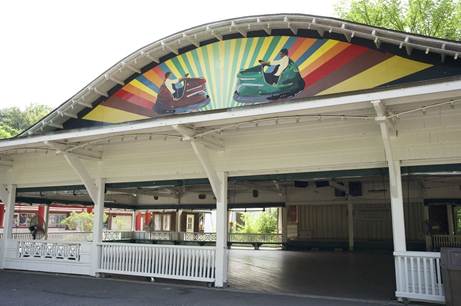
The old bumper car pavilion at Glen Echo Park — amusement-park bones, arts-center soul.
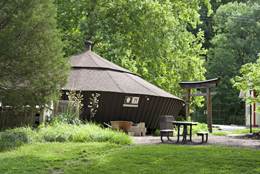
Glen Echo Pottery, one of the park's working studio spaces. |
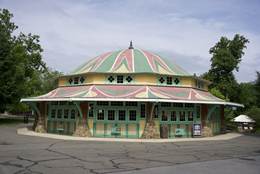
The historic Glen Echo carousel still spins on weekends beneath this hand-painted dome. |
SCIENCE MEETS CULTURE: NIH Nobel Laureate Exhibit Hall Inside the Natcher Building on the NIH campus, a free public exhibit celebrates the Nobel Prize-winning research conducted on these grounds. It's a genuinely humbling experience. Security screening required — bring your ID. |
|
GETTING AROUND
Your Practical Bethesda Survival Guide
Here's the thing about Bethesda that surprises most people: you genuinely don't need a car once you're there. The Metro's Red Line stops right at Bethesda Station, and the entire downtown core is designed for pedestrians. Bethesda has one of the highest Walk Scores in Maryland — not just among suburbs, but among all communities in the state.
For outdoor time, the Capital Crescent Trail offers a gorgeous multi-use path following the old Georgetown Branch railroad line. It's flat, well-maintained, and stretches all the way to Georgetown in D.C. — making it one of the most useful trails in the entire region for both commuters and weekend wanderers.
If you're planning a visit during October, time it for the Taste of Bethesda festival in Woodmont Triangle. Sixty restaurants, five stages of live music, kids' activities, and enough food samples to constitute an actual meal.
Pro Tip: Plan Your Visit Bethesda's restaurants fill up fast on weekends, especially along Bethesda Row and in Woodmont Triangle. For the most adventurous dining, explore the smaller side streets — the best spots are often one block off the main drag. The Downtown Market runs seasonally; check Bethesda Urban Partnership's website for current dates. And the Capital Crescent Trail is at its absolute best in early fall, when the tree canopy turns gold. |
WHY IT MATTERS
The Bigger Picture: What Bethesda Actually Is
Here's the honest truth about Bethesda: it shouldn't work as well as it does. It's a suburb. It doesn't have the history of Georgetown, the grit of Baltimore, or the monuments of the National Mall. And yet it consistently produces world-class food, genuine public art, important scientific research, and a walkable downtown that most actual cities would envy.
The answer, maybe, is in the name. The Biblical Pool of Bethesda was said to heal. Whether or not you believe in that kind of thing, there's something to the idea of a place defined by its intention — a place that decided, long ago, to be welcoming, to invest in beauty, and to build something worth staying for.
From that old stone tavern feeding turnpike travelers to the Michelin-recognized restaurants now feeding a far more cosmopolitan crowd, Bethesda has always been, at its core, a place where people stop, rest, eat well, and feel — however briefly — a little better than they did before.
Which is, when you think about it, exactly what a place named after healing waters should do.